Happy Birthday, Olivia Newton-John

Happy Birthday to English-born Australian musician Olivia Newton-John, b. 1948, best known as Sandy Olsson in the film production of the Broadway musical Grease. She has won four Grammy awards and has recorded five number one singles and two number one albums on the Billboard charts.

Celebrate her birthday with her first Number One single, “If Not For You,” from her first solo album of the same title, released in 1971:

Posted in Birthdays | Leave a comment

Rhythm, Melody, or Technique?

Are you supposed to learn rhythm first? Or the melody? Or are you supposed to use correct fingers and keep good posture? What is the priority?

In twelve years of teaching, I have had students approach a new piece of music in the way that they feel most comfortable. A student with a developed sense of rhythm will like to play a piece directly and quickly,  the way he hears it (if he has heard it before). This causes some problems because most young musicians do not sight read quickly, and the piece becomes frustrating.

I prefer to have students play the correct notes only, even if it very slowly. I correct their fingers, make sure that they keep good wrist position, backs straight, and both feet on the floor. Rhythm is not yet a priority. Young children, about age ten and younger, do not really understand rhythm, but they do understand to hold a whole note for four beats, a half note for two, &c.

Because I am not with the student during the week for practice, I have to make sure that, before the lesson is over, he is able to play the piece and correct mistakes on his own. Again, I look at fingering and other muscle control.

The priority is muscle memory if the question is “What are you supposed to learn first?” The written music is to be a guide, an instructional manual.  If the student has practiced correctly, he will be ready to correct the overlooked mistakes and pick up the tempo. Remember that correct practice does not only mean playing the correct notes but also keeping down those whole notes, resting when required, keeping the wrists off of the piano, and the shoulders back for good posture. All this aids in learning the rhythm correctly.

Rhythm is the backbone of music, which is definitely a priority.

Posted in Articles, Lessons | Tagged , | Leave a comment

Today in Music History, 1988

Today in music history, 1988: American musician Bobby McFerrin’s “Don’t Worry, Be Happy” begins its two-week run as number one on Billboard Hot 100. It is the only a cappella song to claim such an honor. Ever.

Posted in Music History | Leave a comment

Happy Birthday, Bruce Springsteen!

Happy Birthday to American musician Bruce Springsteen, b. 1949, best known as “The Boss.” He continually works with the E Street Band, and their concerts are usually twice as long as most other artists’ concerts, about four hours.

Celebrate his birthday with a well known song, his most “pop rock” tune:

Posted in Birthdays | Leave a comment

Today in Music History, 1936

Today in music history, 1936: Irish musician Martin Fay, best known as fiddler for the folk group The Chieftains, is born in Dublin. He was a founding member of The Chieftains in 1961, although his first passion was classical music. In 1989, the Irish government awarded the group the honorary title of “Ireland’s Musical Ambassadors” for their contribution in popularizing Irish folk music and culture.

Celebrate the anniversary of Fay’s birth with a jolly song from The Chieftains’ twenty-ninth album The Long Black Veil:

Posted in Birthdays, Music History | Leave a comment

Today in Music History, 1983

Today in music history, 1983: American rock band KISS appears on MTV without their trademark make up.
Paul Stanley observes, “Taking the make up off doesn’t change how we feel.”
“It is a stage manifestation of who we are… an extension of our personalities,” declares Gene Simmons.

Their eleventh studio album Lick It Up is released on the same day.

Posted in Music History | Leave a comment

Piano Posture, Elbows and Shoulders

Q: What is correct piano posture in regards to wrists and elbows? I understand that the wrists should be straight, but it is difficult for our young child to keep her wrists straight without touching the edge of the piano. She has to bend them, and that makes her tired.

A: It makes sense that your child would become tired quickly if her posture is not correct at the piano. Correct posture requires no effort. We have addressed how to maintain correct posture of the fingers and wrists in a previous article. The fingers should be slightly curved and the wrists straight. If you see that your child is having a difficult time keeping her wrists straight, then she may be sitting too low in comparison to the keys.

Her forearms should be parallel to the floor. An adjustable stool or bench is ideal for a family with many pianists ranging from small to tall. On static benches, young children will have to sit on something to bring them up to where their forearms are parallel to the floor, their wrists are straight, and their fingers slightly curved. Pillows are not recommended because they sink in and because the child tends to slip off of them.

The elbows should not open outward to achieve this posture. If she wants to open her elbows outward to achvieve straight wrists, then she is still too low in proportion to the keys. This kind of posture will cause her to turn her wrists in ways that they are not designed to move. In keeping her elbows out, she risks tiring her shoulders.

Be sure that her elbows are not directly below her shoulders. If they are, then she is too close to the keyboard. Her arms will not have the space for her to move along the keyboard as she becomes more proficient. Elbows should be at about a 120 degree angle, that is, aligned with the front of the ribcage.

Shoulders should be pulled back but not so much that great effort is required. Back posture plays a considerate role in proper breathing, blood flow, and, eventually, stamina at the piano.

Posted in Articles, Perfect Practice | Tagged , | Leave a comment

Today in Music History, 1923

Today in music history, 1923: American musician Hank Williams, best known as a country singer and songwriter, was born in Alabama. He recorded eleven Number One singles on the Billboard Country and Western charts and is considered an influence on many of today’s country artists.

Enjoy this single that made it into the Grammy Hall of Fame in 2001:

Posted in Birthdays, Music History | Leave a comment

Happy Birthday, Ron Blair

Happy Birthday to American musician Ron Blair, b. 1948, best know as bass guitarist for rock band Tom Petty and the Heartbreakers.  He left the band in 1982, rejoined them twenty years later to perform for their induction into the Rock and Roll Hall of Fame, and has since been touring and recording with them.

Celebrate his birthday with Tom Petty and the Heartbreakers’ Super Bowl XLII Halftime Show performance:

Posted in Birthdays | Leave a comment

Today in Music History, 1819

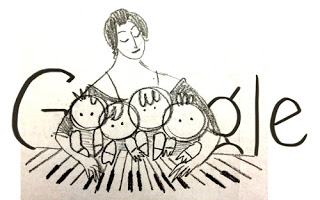
Today in music history, 1819: Romantic era musician Clara Schumann (née Wieck) was born in Leipzig, Germany. She composed many pieces for the piano and violin/piano duets but is best known as a talented pianist who played concerts from memory.

Here is a “Google Doodle” draft for 2012’s observance of Mrs. Schumann’s birth, one in which she is teaching four of her eight children.

clara draft 2

Posted in Birthdays, Music History | Leave a comment