Mrs Marie from At Home Music, Inc, demonstrates how to play the simplest scale.
We hope that these videos help you to practice correctly.
Mrs Marie from At Home Music, Inc, demonstrates how to play the simplest scale.
We hope that these videos help you to practice correctly.
Q: My daughter goes to a Montessori preschool where she takes individual piano lessons once a week. I come from a place where children are taught to read music at an early age, so I am surprised to hear from the piano teacher that my daughter will learn only by ear. Why does this school not teach to learn to read music?
A: It is the Montessori method that young children learn the sounds that a musical instrument makes by manipulating it, that is, to learn what makes a loud tone or a high pitch. A Montessori student will learn music by playing music. Later on, when the student has a solid reading foundation, typically in first grade, musical notation is introduced, and the student learns music by reading music.
A preschooler is usually still learning to develop her fine motor skills. The Montessori method of learning music allows her to focus on hearing the music and controlling her muscles. She learns the tone that each key makes and the patterns of a scale by looking at the keyboard. This allows her to learn the instrument itself, what the instrument can do.
Most quality Montessori schools encourage families to adopt a Montessori lifestyle in the home. This means that you would help her practice piano at home by allowing her to figure out the song by ear. You can sing along, for example, “Yankee Doodle,” if she is learning it during school.
You may be tempted to hire a private teacher to teach her to read music, which is discouraged by the Montessori method. It is fine to hire another teacher, but to keep the focus on hearing music and developing fine motor skills, please be sure that the private teacher instructs ear training only.
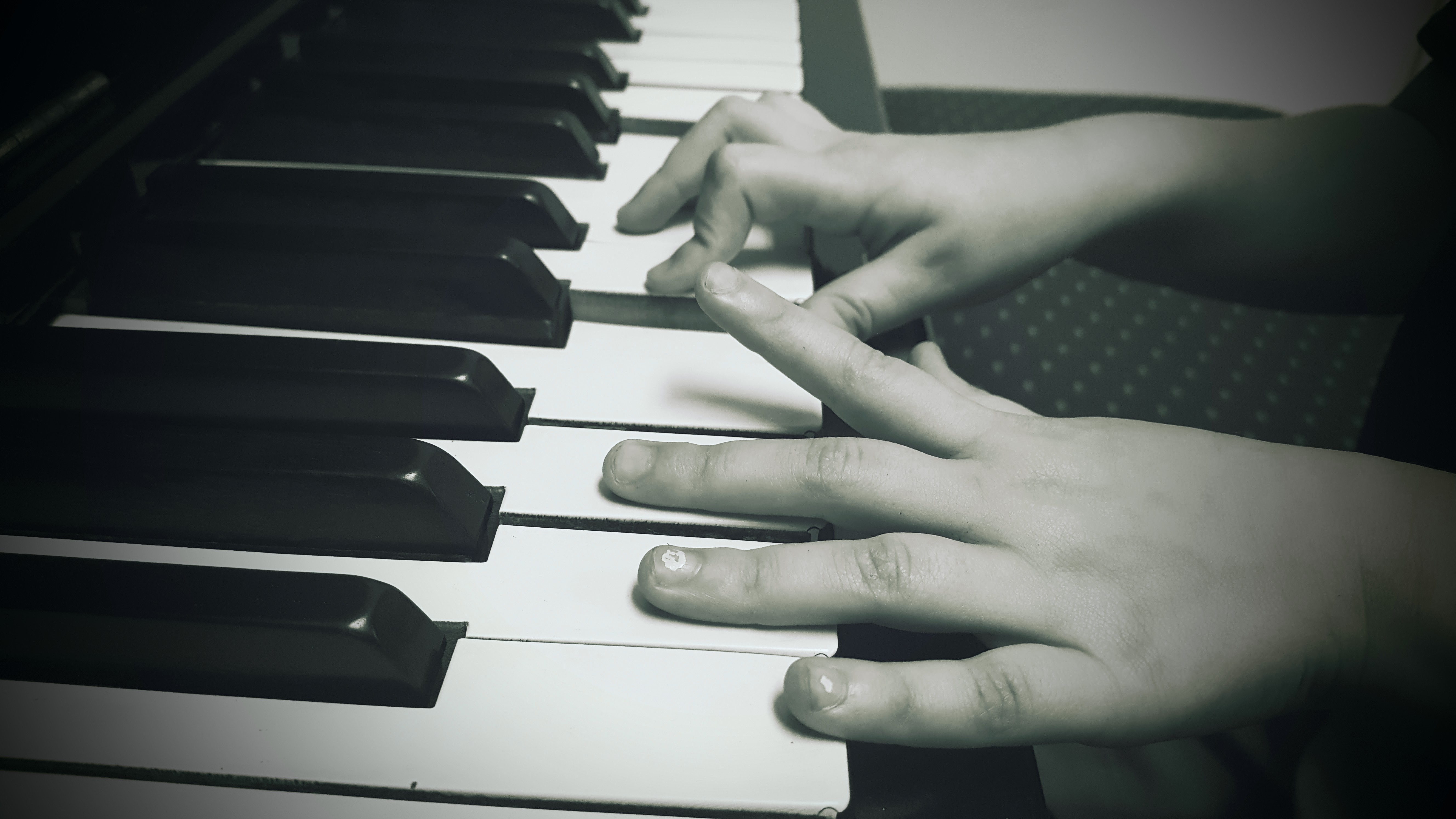
Young children can learn to play piano.
Q: ” What age is good to start taking piano? ”
A: Most children are ready to begin lessons when they reach first grade. However, if you would like for your child to learn to play by ear, start him as young as two or three because he does not have to read. In fact, the Montessori method of teaching music requires preschoolers not to read music and to play exclusively by ear. Some piano instructors are willing to teach Kindergarteners and preschoolers to read music. It is helpful that your child have an understanding of the first seven letters of the alphabet, which are used as the musical alphabet. Knowing left from right is crucial, too. Are you worried that your child may be too old to learn piano? Many accomplished pianists began lessons in high school. Their understanding of reading and mathematics helped them advance more quickly. A teenager who has been playing for a month will show more progress than his preschool counterpart. Do not put off piano lessons too long. A teenager’s fine motor skills are less easily trained than a young child’s. Typically, beginning piano students start taking lessons between ages 6 and 10. Bear in mind the maturity and disposition of your child. A very calm, mature 4 year old may do very well sitting for a 40 minute lesson while his hyper, distracted 7 year old brother may sit for only 20 minutes. Some piano teachers will divide an hour’s lesson to teach two students in one family. 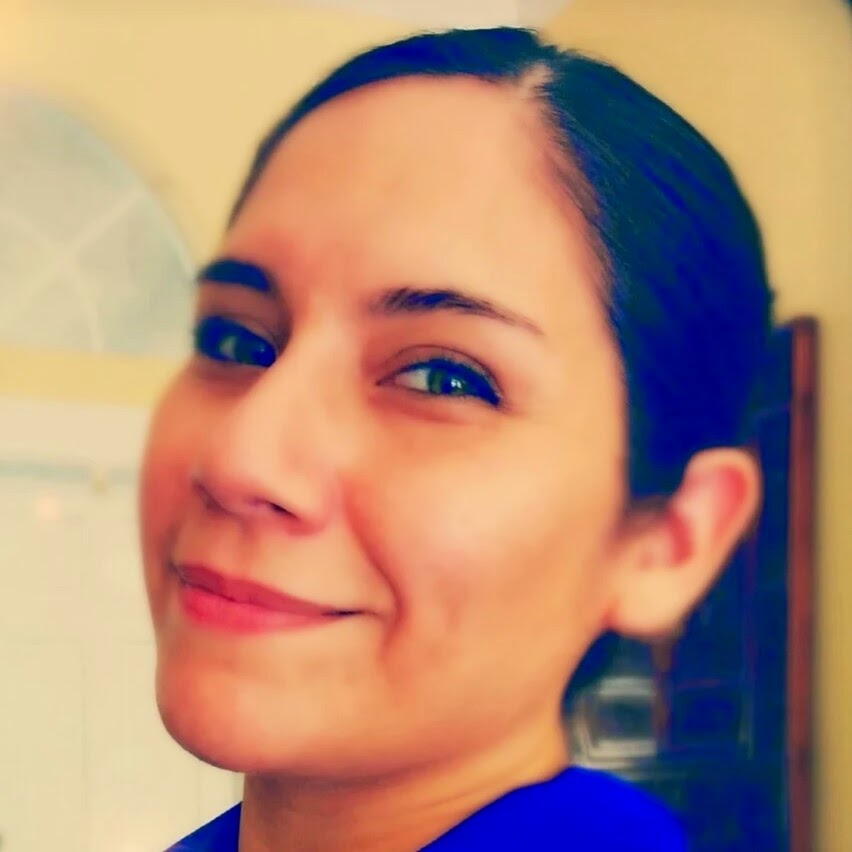 Marie Sleppy, professional piano instructor Mrs. Marie has been teaching piano for 15 years and plays the piano weekly for a parish.
It’s the beginning of the school year and time to start thinking about recitals.
Recitals?
Yes! Christmas is right around the corner in the world of performing arts, and preparations are being made. Ask your child to start thinking about what pieces he will play. Your piano teacher may require him to play them from memory, so repetition is key. Your child may take a couple of months to learn the pieces. At the beginning of November, he should be practicing them for maintenance.
Your child’s teacher may ask you about venues for recitals. If you are parish member, you may look into booking the hall at a lower price than a non member. How about outdoors? Winter in Miami is perfect for spending outdoors! Offer to find a caterer for the refreshments. There is much planning that goes into a recital, and you will be appreciated for any little work that you put forth.
Do you have more than one child who plays music? Ask your child’s teacher if your two or three children (or yourself!) can play a duet. Most recitals tend to get a little bit monotonous when performers just play solos. A change of pace in the program will create interest.
With a little bit of creativity and work from everybody, you will experience a really great show and create a lot of great memories.
If you today is your birthday, you share it with
You are in good company! We wish these gentlemen musicians and you a happy birthday.
Enjoy singing and playing by The Edge with a song from U2’s 1991 album Achtung Baby.
If your child continues piano lessons during the summer, then he will be better prepared than his counterparts when the school year comes around. For every lesson missed, your child experiences not just a pause in progress but regression. He forgets how to read musical notation. His finger muscles forget how to move.
Just like with mathematics or reading or tennis, playing piano requires constant attention to produce results.
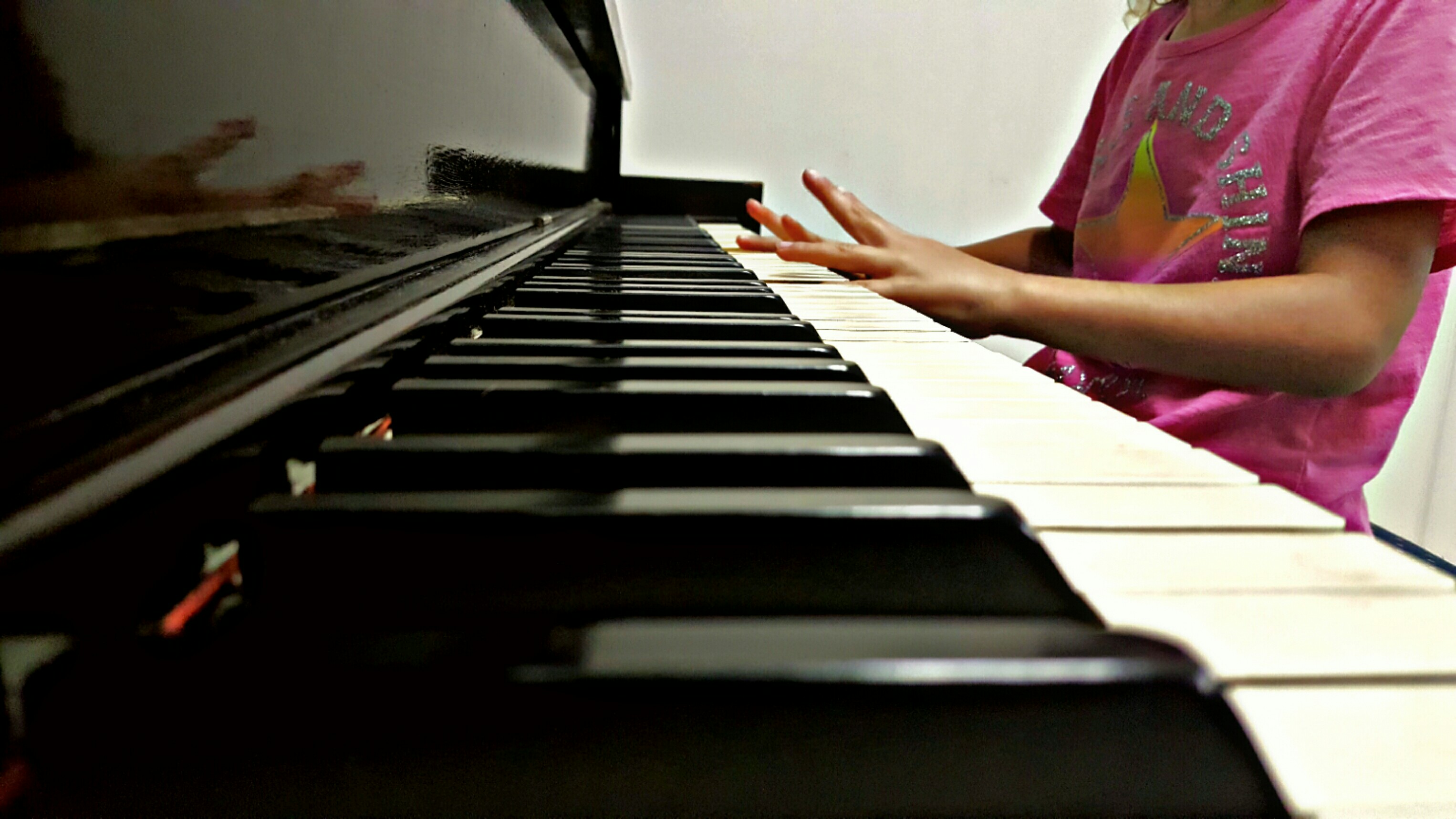
A first grader takes piano lessons through the summer.
What do these mean? If you have a minute (yes, it’s under a minute), watch our newest video. You can do this to all triads (chords of three notes). Try it for F and G majors as they, like C Major, consist of only white keys in root position.
A few students participated in a springtime recital last weekend. In order of appearance:
All of the participants played their pieces from memory.
Happy Birthday to Bono, born 1960, best known as lead singer for Dublin-based rock group U2. He has collaborated with numerous artists such as Frank Sinatra, Luciano Pavarotti, and Johnny Cash. The list goes on. Bono has won 22 Grammy Awards with U2. They were inducted into the Rock and Roll Hall of Fame in 2005.
Celebrate his birthday with this very early recording of “Stories for Boys.”
I use this teaching technique frequently, asking the student to play one clef (or hand) while I play the other. It is good to use after a student has been working on a piece for several days, having learned the notes yet not having mastered the rhythm.


