8 Proven Ways to Help Your Child Thrive in Music

As parents, we all want to see our children succeed, especially when learning something challenging like music. It’s easy to feel like stepping back when things get tough, but with the right approach, you can help your child overcome obstacles and make steady progress. Here are 8 powerful and practical tips to boost your child’s music journey:

  1. Schedule Practice Time: Don’t wait for a free moment—set a daily practice time and stick to it. Consistency is key.

  2. Communicate with the Teacher: Your child’s teacher understands their learning style and can offer personalized advice tailored to your child’s needs.

  3. Listen to Professionals: Encourage your child to listen to studio recordings. It’s inspiring and helps build a sense of musical style—not imitation.

  4. Review Old Pieces: Revisiting previously learned music builds confidence and warms up fingers, making practice sessions more effective.

  5. Tie Music to Interests: Connect music to what your child loves. If they like airplanes, create lyrics or stories about flying to keep them engaged.

  6. Stay Positive and Encouraging: Celebrate small wins and progress. Encouragement fuels motivation, especially when learning is tough.

  7. Break Pieces into Chunks: Help your child master music in manageable sections instead of overwhelming them with the whole piece at once.

  8. Focus on Strengths First: If certain passages are difficult, skip them temporarily. Concentrating on strengths builds confidence and progress.

Try these tips, and watch your child’s passion and skills soar! Remember, your support makes all the difference.
Keep cheering them on!

Every note played is a step forward. With patience, encouragement, and these tips, your child will build not only skills but also confidence and a lifelong love for music. Ready to see your child’s musical journey soar? Let’s make practice joyful and rewarding together!


Posted in Uncategorized | Leave a comment

Making Better Practice

Does practice really make perfect? It certainly makes progress when executed properly, so the saying ought to be, “Proper practice makes progress,” I think.

Summertime is typically a season in which we start our new practice goals with energy but quickly realize that a lax routine allows for practice to go by the wayside. One way that you can combat this mindset is by keeping a practice log. You can find one here.

I’ve shared one tip on how to clearly see what you’ve been practicing without littering your log with scribble scrabble. You may find that here. 


Tip #2 – DOT THE MINUTES

If you aim to practice everyday, which would be A-M-A-Z-I-N-G, your log will fill up and look cluttered. The purpose of a log is to look back and analyze progress, but how can one analyze with all that writing?

Think about how often you practice and how long your regular practice sessions are. Draw a dot to mark particular increments of time. A dot may represent 10 minutes or 15 minutes.

For example,
If you had a busy day yet managed to play a scale or two in the morning, sight read a little bit after lunch, and go over a mastered piece before bedtime, you might just write one dot to symbolize that you practiced 15 minutes that day, and give yourself an ice cream because a day like that takes discipline!

If you find that your regular practice time has increased to a point where all you see are dots, which is a very good thing, consider changing the pen color or drawing a circle around the dot to represent 30 minutes. Be creative and consistent.

Stay tuned for next week’s last practice log tip!

Posted in Articles, Motivation, Perfect Practice | Leave a comment

Maintaining Skills During the Summer

With the school year coming to an end, many families will go without the routine that school offers. Music students often lose their skills during this time because summer usually allows for a relaxed schedule, but I would not want that to happen to my students!

One thing that you can do to maintain your child’s skills is to keep a practice log. This helps because you can:

  • Keep an eye on practice time.
  • Clearly see if there are a few days without practice.
  • Maintain focus on musical goals.

To use your log more effectively, I’ll share a few tips during the next few weeks.

Download your FREE practice log PDF here.


On with the show!

Tip #1  – MAKE A LEGEND

Just like making a legend of a key for a map, make a legend for the different things that you will be practicing.

Draw a box to make a chart on one of the blank sections of the practice log. If you like to work on scales, drills, and sight reading, the first column of the chart might have the simple drawing while the second has the label.

For example:
a zigzag to represent Scales
a round swirl to symbolize Drills
parallel lines to mean Sight Reading

This will keep your log from being too cluttered when it starts to fill up. You will also save time when writing down what you have practiced. It might also save you from quickly scribbling your work and then coming back later to not being able to read it.

See you next time, and have happy practices!

Posted in Articles, Perfect Practice | Leave a comment

Push Them Out of the Comfort Zone

Both my parents worked outside the home. My mother used to be an editor for the local newspaper. I took advantage of her editing skills to spruce up my school assignments.
⠀⠀⠀⠀⠀⠀⠀⠀⠀
It’s not easy being the music teacher’s children, I imagine. One has to learn music proficiently if it is expected. Thankfully, all of my children learn music easily, and most of them seem to enjoy it.
⠀⠀⠀⠀⠀⠀⠀⠀⠀
I push them a bit harder out of their comfort zones than I do my students. I do not expect them to become concert pianists or international touring rock stars, but these are the skills that I know and can pass on.

I don’t want my children in their adulthood to claim that I let them quit.  In what ways so you push your children or if their comfort zones ?

Posted in Articles | Tagged , , , | Leave a comment

What Do You Want To Be?

Did you always know what you wanted to be? Did you always want to be a spouse, parent, cop, fire fighter, mechanic?⠀⠀⠀⠀⠀⠀⠀⠀⠀
⠀⠀⠀⠀⠀⠀⠀⠀⠀
I have always enjoyed teaching.When I was in little, I would line up my stuffed animals and teach them the alphabet.  In high school, I took a class that allowed me to teach preschoolers everything from phonics to nutrition. ⠀⠀⠀⠀⠀⠀⠀⠀⠀
⠀⠀⠀⠀⠀⠀⠀⠀⠀
My first piano teacher saw teacher qualities in me when I would work patiently with duet partners. My drill sergeants in the Army would ask me if I aspired to become a drill sergeant myself… I think because I was good at leading cadence.⠀⠀⠀⠀⠀⠀⠀⠀⠀

(Try running and singing simultaneously.
Fun times! )

⠀⠀⠀⠀⠀⠀⠀
I’m a third generation teacher. My mom and dad taught catechism, and my maternal grandmother taught grade school.  I have been a homeschooling mom since our firstborn heard my singing in the womb, and I’ve taught our five children to read, write, solve mathematics problems, and play piano.⠀⠀⠀⠀⠀⠀⠀⠀⠀
⠀⠀⠀⠀⠀⠀⠀⠀⠀
You could say that teaching is my calling,
music my passion, and
family my vocation.⠀⠀⠀⠀⠀⠀⠀⠀⠀
⠀⠀⠀⠀⠀⠀⠀⠀⠀
I’m very blessed that I get to live out all three everyday.

Posted in Articles | Tagged , , | Leave a comment

Performance Fail: I Forgot My Recital Piece!

I was thirteen, playing a memorized, four-minute piece at the Dade County Auditorium. I thought that I was well-prepared, but a minute into my piece, I forgot where my hands were supposed to go!

Uh-oh. I took my hands off the keyboard, which obviously stopped the music. There was dead silence. I clenched my fists, took a deep breath, started the piece again from the top, and finished it beautifully. It is one recital that I will never forget.

Funny, I’ve forgotten the recitals in which I didn’t make major mistakes!

Now that I’ve shared my “performance fail,” I’d like to share some tips to help you have a successful music recital:

  • Be prepared. Know your piece very well. Practice, practice, practice, and repeat. You should be able to start the piece from any measure.
  • Show up to the recital venue early. Fix any hair or wardrobe malfunctions. Chit chat with other performers. This will calm your nerves.
  • Sit on your hands. Yes, sit on them to keep them warm. The air conditioning keeps the air cool and dry, causing your fingers to be cold when you approach the piano. For the time that the student performer is playing before you (3-5 minutes), do what you can to keep those fingers warm.
  • Remember that the audience can’t tell the difference. Most people are not trained in music and don’t know what your piece is supposed to sound like. If you flub or skip a part or repeat a part, just keep going. They love it anyway.

Before your recital, play for your friends and family on as many pianos as you can. Call retirement homes and ask if they have pianos in their recreation rooms that you can play.  The residents will love you for it and don’t mind mistakes and repeated pieces. The only way to learn to perform is to perform.

Above all, don’t forget that all the great performers were once students just like you.

Break a leg!

Posted in Articles, Motivation | Tagged , , , | Leave a comment

Acoustic or Digital?

Many piano teachers will answer plainly and strongly, “Acoustic, all the way.” I have a different attitude which is totally biased.

In the 80s, my parents bought an acoustic upright for my brothers and me to learn piano. They didn’t come from musical families (though I have an uncle who used to busk on accordion in the streets of a village in the Andes). My parents believed that a holistic education included music, so one by one, my brothers and I took piano lessons.

When I married, I took the piano with me into my husband’s home. We had children who learned on the same instrument. I played piano for a church that moved to a location that already had a piano, so the congregation gave me the instrument. We had two acoustic pianos in our home. How rich!

The South Florida humidity and insect population didn’t do much kindness for our two pianos. Eventually, felts unglued, strings rusted, and wooden keys swelled. We were struggling to practice on these acoustic instruments. Soon we acquired an electric keyboard, which really was an upgrade because all the keys played the right tone, but it didn’t have the feel of a piano nor the necessary range.

I have to add that having a keyboard was really helpful in that anyone who wanted to practice could do so without affecting the volume of the household. With seven people living together in a modest house, the volume of an acoustic piano competes with watching a football match on television or listening to a podcast while doing chores. The electric keyboard allowed the pianist to plug in earphones and practice quietly.

Enter the Digital.

One Christmas morning, we woke up to find a digital piano sitting in the living room, just waiting to be played. This machine is a beauty! Full weighted keys. Full 88 key range. Damper pedal. EARPHONE JACK! It is so light, too, in comparison to an acoustic. We easily moved it from room to room, depending if we wanted to rehearse singing in a bedroom or singing carols together by the tree. Talk about an upgrade!

Now, when asked, “Acoustic or digital?” my answer is, “Yes.”

We can’t have an acoustic in our current home. We certainly can’t have one if we move into an RV. If we ever live in a sprawling house with great, many rooms, I’d probably like to have a Bösendorfer Imperial Concert Grand in one or two of them.

Whichever route you’d like to go, acoustic or digital, take into consideration your family’s lifestyle, the size of your home, how the ambiance of a played piano will affect other family members, and the cost of maintenance. Above all, be sure to play the instrument.

Posted in Articles, Piano Keyboards | Tagged , , , , , | Leave a comment

Bigger Bang for the Buck

Many parents want to be reassured that they are not wasting their money on music lessons, so they ask me how often should students practice their instruments. Though there really is no hard and fast answer, I do tend to give a rule of thumb: an hour a week, which seems doable for busy families, but if the child is sitting at his bench, going over easy drills, taking several breaks, and just killing time, he is practicing – but not really.

The kind of practice that will end in results involves in-the-moment self-assessment. This is a profound concept for young children to understand, but communicate it to him in familiar terms. It’s not just the amount of time that he’s on the bench that counts as practice. He has to be listening to his playing, perhaps beginning more slowly than normal so that he has a little bit of time to think between notes during the more difficult passages.

Practice involves repetition. When he does play the passage or piece correctly, ask him to play it again. “But I did.” Ask him to show you that he can do it again. You may want to spend a few minutes per week actively listening to his playing to recognize progress. Some children may require careful monitoring during practice. After practicing, have a short discussion on what were the harder parts and how he might understand them better.

If your child wants to learn, he’ll improve with time. The goal is to improve performance. The more he practices with focus on improvement, the better musician he’ll become sooner, and you’ll be getting bigger bang for you buck.

Posted in Articles, Motivation, Perfect Practice | Leave a comment

Preparing to Play Piano

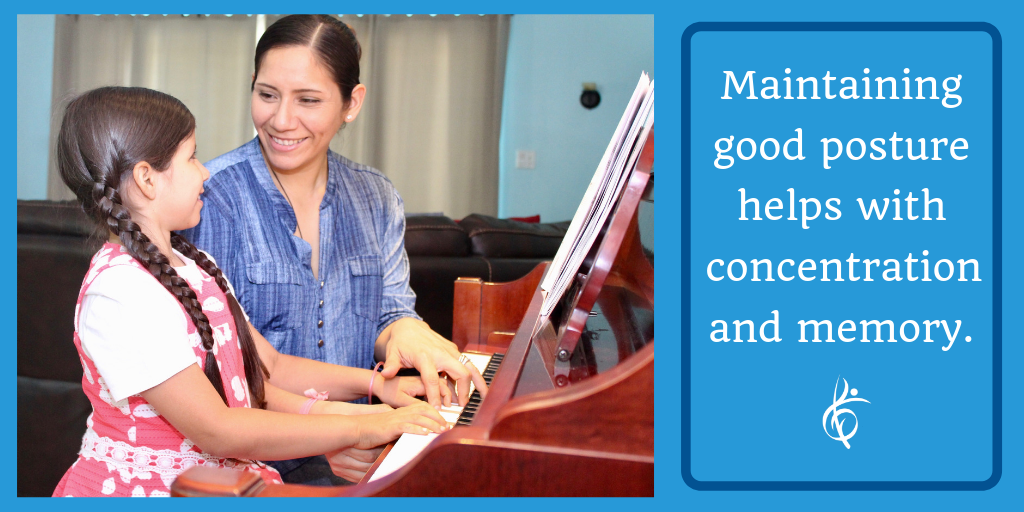
Piano teachers don’t just teach music. We teach posture and coordination, resilience and confidence. These life skills can be learned in other activities such as ballet or karate, but do you notice that playing an instrument, unlike ballet or karate, requires sitting? Lots and lots of sitting?

Your young musician may practice for a few minutes then declare, “I’m tired.” You think, Tired of sitting? Really?
Believe me, he really is tired. This is because his muscles are tired from poor posture.

Sitting at the piano is not like sitting at a desk, where one can lean back on the chair. If you’re using a chair for your piano bench, have your child sit on the very edge of it, with his legs able to move about. An important detail is to keep his knees below the hips. Trying to sit upright if the knees are at the same elevation as the hips puts a strain on the lower back, which forces a slouch. Bringing the knees down will keep him sitting upright and, not to mention, improve circulation, which keeps him awake.
If his feet do not reach the floor, then a small step stool placed at his feet will offer support.

A keyboard at the dining room table is too highly placed. His wrists should be straight and his elbows slightly greater than a right angle. If you put him on a high stool so that his wrists are correct, you’ll see that his knees will bump against the lower lip of the table, and he’ll be too far back. He’ll have to hunch over and declare, once again, “I’m tired.” A solution would be acquire a keyboard stand (double braced is better) and a music bench. Both these items are adjustable and will improve his posture, thus increasing his practice time.

Posted in Articles | Tagged , , , , | Leave a comment

Back to School!

It’s every parent’s favorite time of year!

I write that tongue in cheek because, as a parent myself, I enjoy the lazy summer days, but I also really like the structure and predictability of the school year. Above all, I love the anticipation of what my children will learn and what events will take place.

While the search for the right soccer or swim team or the perfect karate or ballet school commences, you have found yourself reading this blog post, which means you are looking for a music teacher.

We’ll guide you along way.

Look no further. At Home Music teachers are friendly, experienced teachers who travel to your home to save you the driving hassle, so you get to stay home and help Sophia and Caleb with their homework while juggling dinner and laundry during Olivia’s piano lesson. Yes, we know a thing or two about real life because we live in real life.

Registration is super easy, too! It’s just a phone call, maybe 20 minutes, some questions about the student’s musical background and general mathematics and reading skills, discussions about a proper instrument, and of course, scheduling. Please take a look at our policy page.

Are you concerned that, because your child may be on the spectrum, we will refuse lessons? We will match you with a teacher who will gladly follow IEPs. I am a mother of a handful of children and know how differently each child learns. Your child will be given the same respect and attention that all children deserve.

If you’ve gotten through this whole article, I tip my hat to you as you are clearly serious about beginning lessons. Call today. It’s easy peasy!

piano teacher

Mrs Y. Marie Sleppy,
Founder and Director
At Home Music, Inc.

Posted in Articles, Piano Teachers | Tagged , , | Leave a comment